
Home batteries and industrial battery storage
Use the power you generated during the day in the evening, flatten your peak demand and provide back-up power where it is needed. From a home battery of a few kWh to an industrial BESS installation.
Three reasons to install a battery.
Which reason weighs heaviest in your case decides the size and the type. That is a calculation, not a matter of going as big as possible.
Use more of your own power
What is generated during the day but not used goes into the battery instead of into the grid. In the evening you take it back out. This is the classic reason in homes.
Flatten peak demand
For business customers the Belgian capacity tariff drives part of the bill. A battery that absorbs the peaks lowers that monthly peak and often pays back faster than in a home.
Back-up power
During an outage a defined circuit keeps working: refrigeration, server cabinet, gate, lighting. That requires an inverter capable of it, so it is chosen up front.
- Sizing. Based on quarter-hour values from your digital meter, not on a rule of thumb.
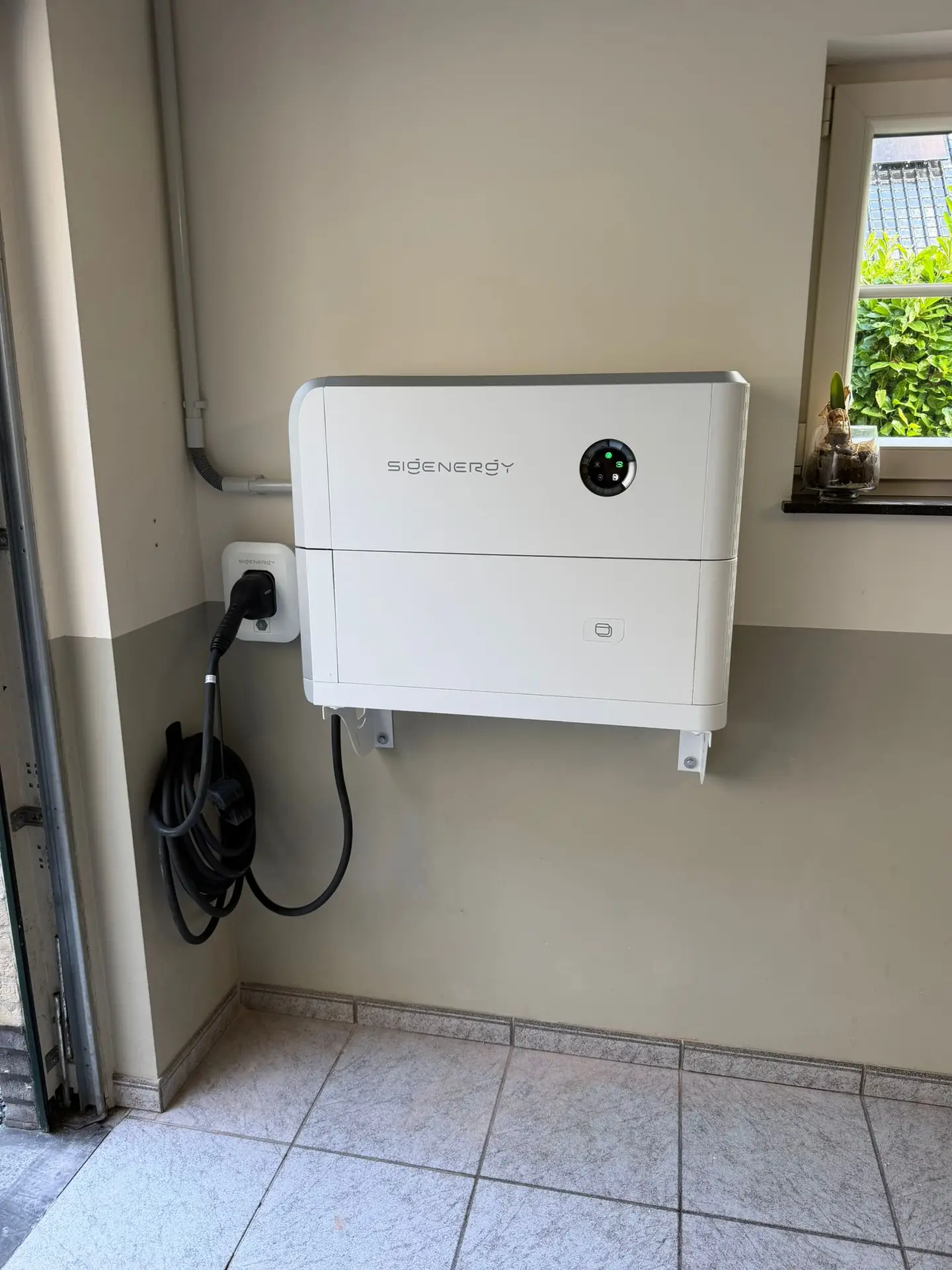
- Installation. Indoors or in a separate cabinet, with attention to ventilation, temperature and fire safety.
- Coupling with solar. Keeping the existing inverter where possible, with an AC-coupled battery.
- Control. Charging and discharging on price, on sun or on peak demand, through the energy management system.
- Industrial BESS. Container set-ups and cabinet systems, in cooperation with the grid operator where required.
- Monitoring. Insight into charge cycles, battery health and actual savings.
How we work out the right size.
We request your consumption data from the grid operator or read it from the meter. That shows us the real peaks and the real evening consumption.
For each battery size we work out what it returns and when it pays for itself. Sometimes the answer is that you are better off waiting.
Battery, inverter and protection, connected to the board. For an industrial set-up a study and consultation with the grid operator come first.
After a month we review the first figures and adjust the control to your actual pattern.
Frequently asked questions about battery storage
Not necessarily. For a business customer a battery can pay off without solar too, purely by flattening peak demand or by charging when electricity is cheap. In a home, the combination with solar is usually the reason.
Usually yes. With an AC-coupled battery your current inverter stays in place. During the site visit we check whether your board and your inverter can handle it.
Only if it is equipped for that. By default an inverter shuts down during a grid outage for safety reasons. If you want back-up power, we choose the right unit up front and define which circuits keep working.
Manufacturers usually give a warranty expressed in years and in charge cycles, with a guaranteed remaining capacity. We put the exact warranty conditions of the chosen brand in the quote, so you compare like with like.
Modern systems have a battery management system that monitors temperature, voltage and current. The location matters too: dry, ventilated and not in a living space. We follow the manufacturer’s instructions and the Belgian AREI/RGIE rules.
Want to know whether a battery pays off for you?
Give us your consumption data and we will work it out, with no obligation.